Looking at the year ahead, a main focus for NOFA NJ will be exploring value-added processing and working to get more local foods onto the shelves of retail partners. As NOFA NJ assumes the cost (and the risk!) of trials, literally working through the process of production to finished product, our goal is to create stable market opportunities for our community of producers and get more local food into the hands of NJ eaters.
This past year, I was able to trial oilseed pumpkins with support from a Specialty Crop Block Grant administered by the Grants Division of the New Jersey Department of Agriculture. In the trials, Hungry Work Farm produced hulless pumpkins (AKA pepitas) to get an understanding of which varieties offered the best yields, to explore small-scale pumpkin processing, and to engage local eaters around freshly roasted pumpkin seeds and pumpkin seed oil.
As someone whose life is dominated by food, and having grown up enamored of television shows like Unwrapped, Dirty Jobs and How It’s Made, I’m ever-interested in how the food products we know and enjoy wind up at the local grocery store, and why certain products more or less available (and expensive) than others. I’m also eager to produce my own supply of pantry favorites. Pumpkin seeds are a great snack, chock-ful of magnesium, zinc, fiber, healthy fats and protein.
Like many food products, I’m left wondering why we aren’t producing our own pumpkin seeds and whether a little bit of processing infrastructure can help open up a market opportunity for NJ farmers and improve the quality of food products for NJ eaters.
Pepitas Vs. Pumpkin Seeds
Perhaps the curiosity around pumpkin seeds and oil is due to my fondness for the Fall season, cooler weather and, of course, Halloween! If you’ve carved jack-o-lanterns, you’ve probably thrown the seeds in the oven and toughed your way through the chewy, thick white seeds. Even though you can buy these in grocery and convenience stores, it’s not good eating.
Pepitas, on the other hand, are. Spanish for “little seed”, pepitas are also known as hulless seeds, lacking the tough outer shell that most carving pumpkins contain. Pepitas are much tastier, easier to eat, and likely much easier to digest, but the pumpkins themselves tend to be smaller and harder to come by. For this project, I decided to trial five varieties, and had to purchase from three different seed companies (Baker Creek, Adaptive, Johnny’s, and High Mowing) to source what I was looking for. I settled on growing Pie Pita, Emerald Naked Seeded, Naked Bear, Lady Godiva, and Kakai pumpkins.
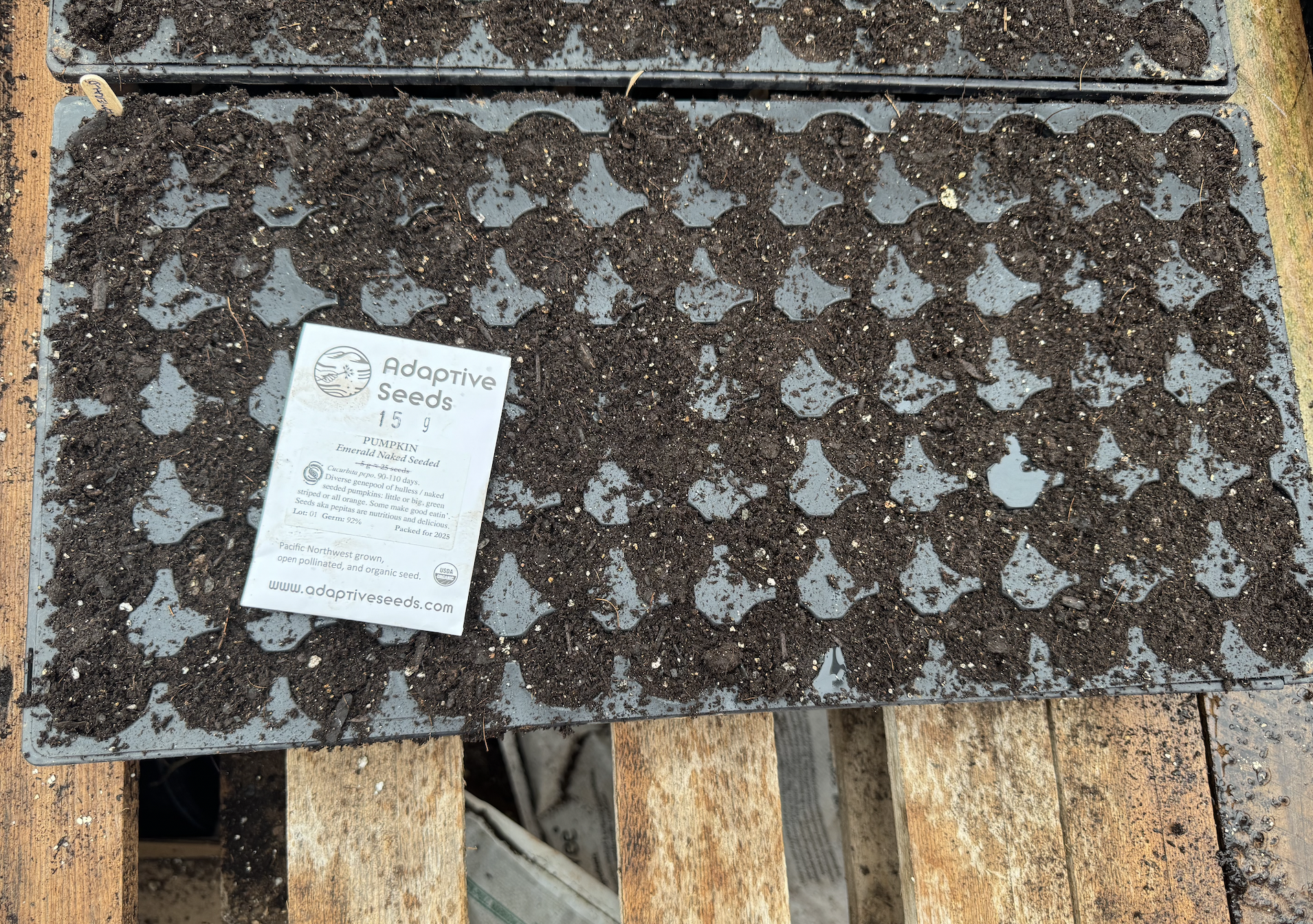
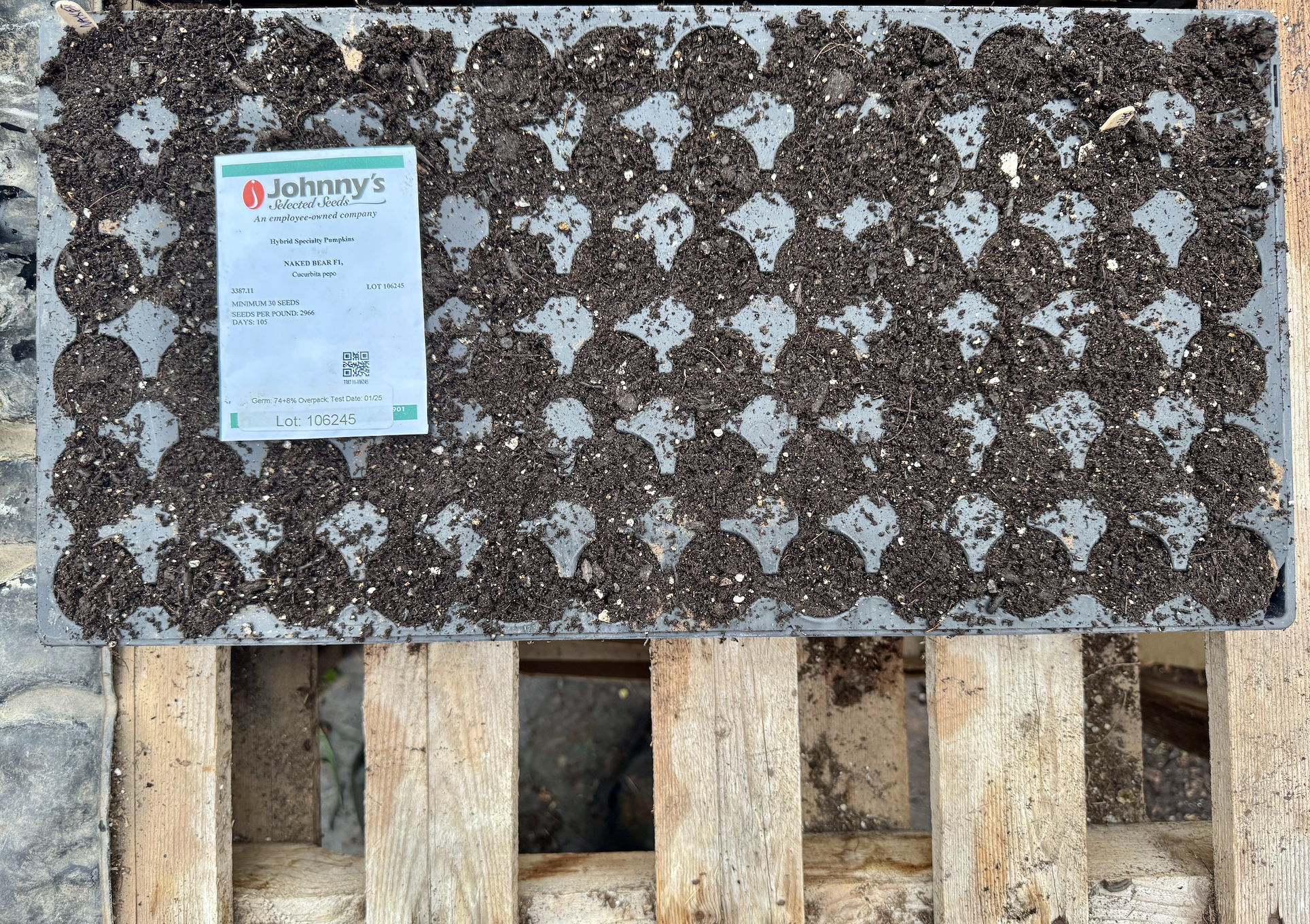
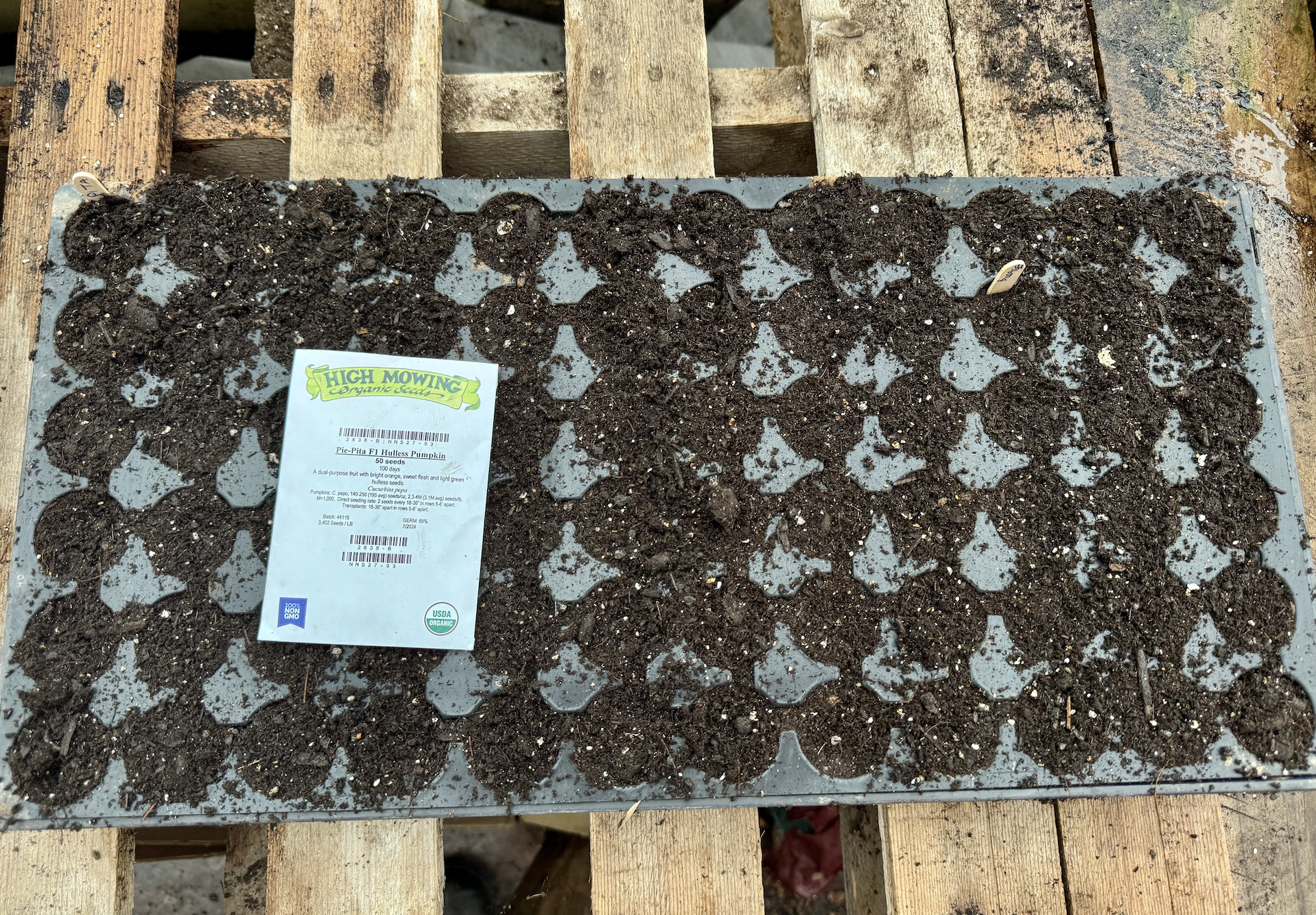
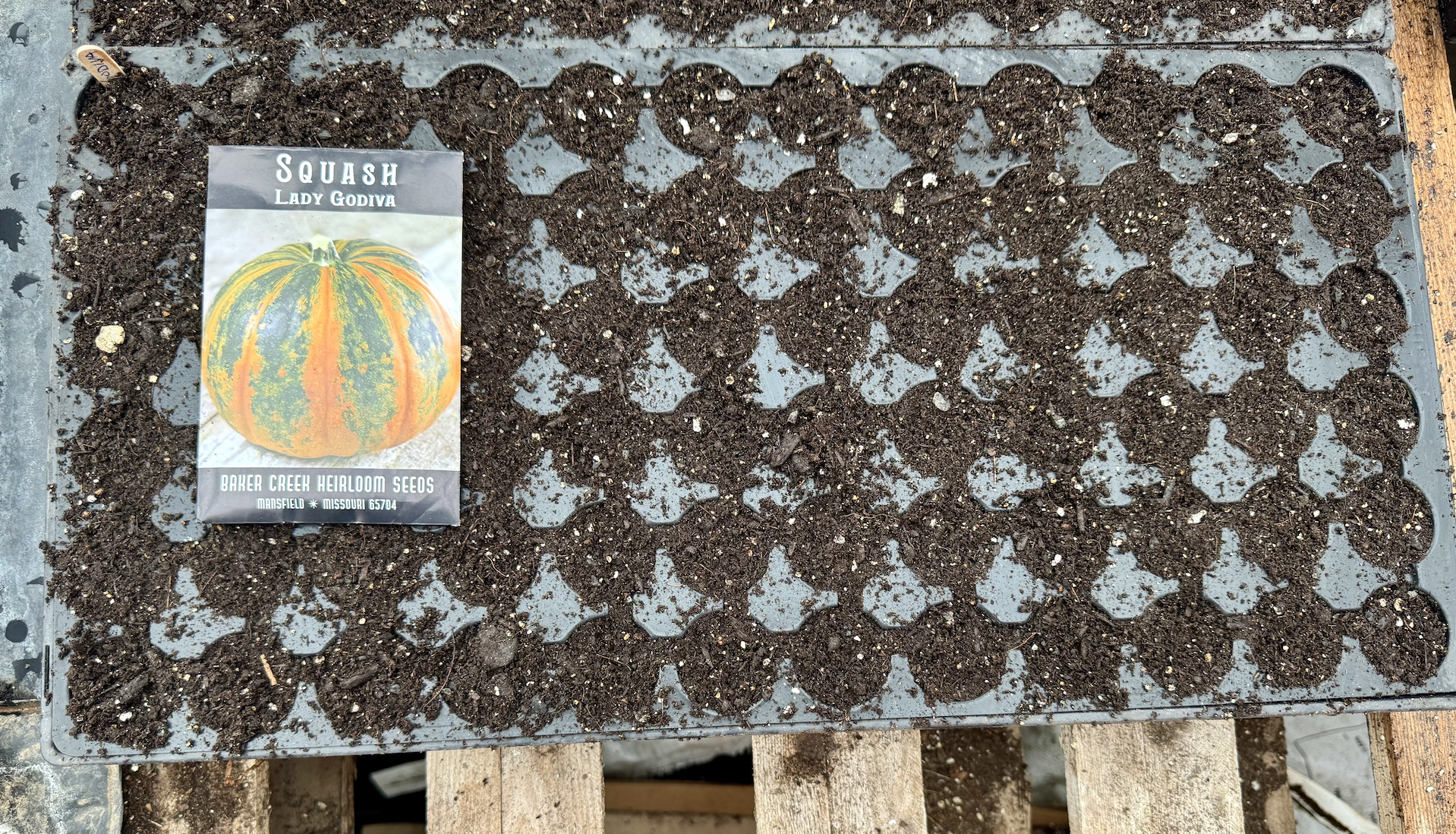
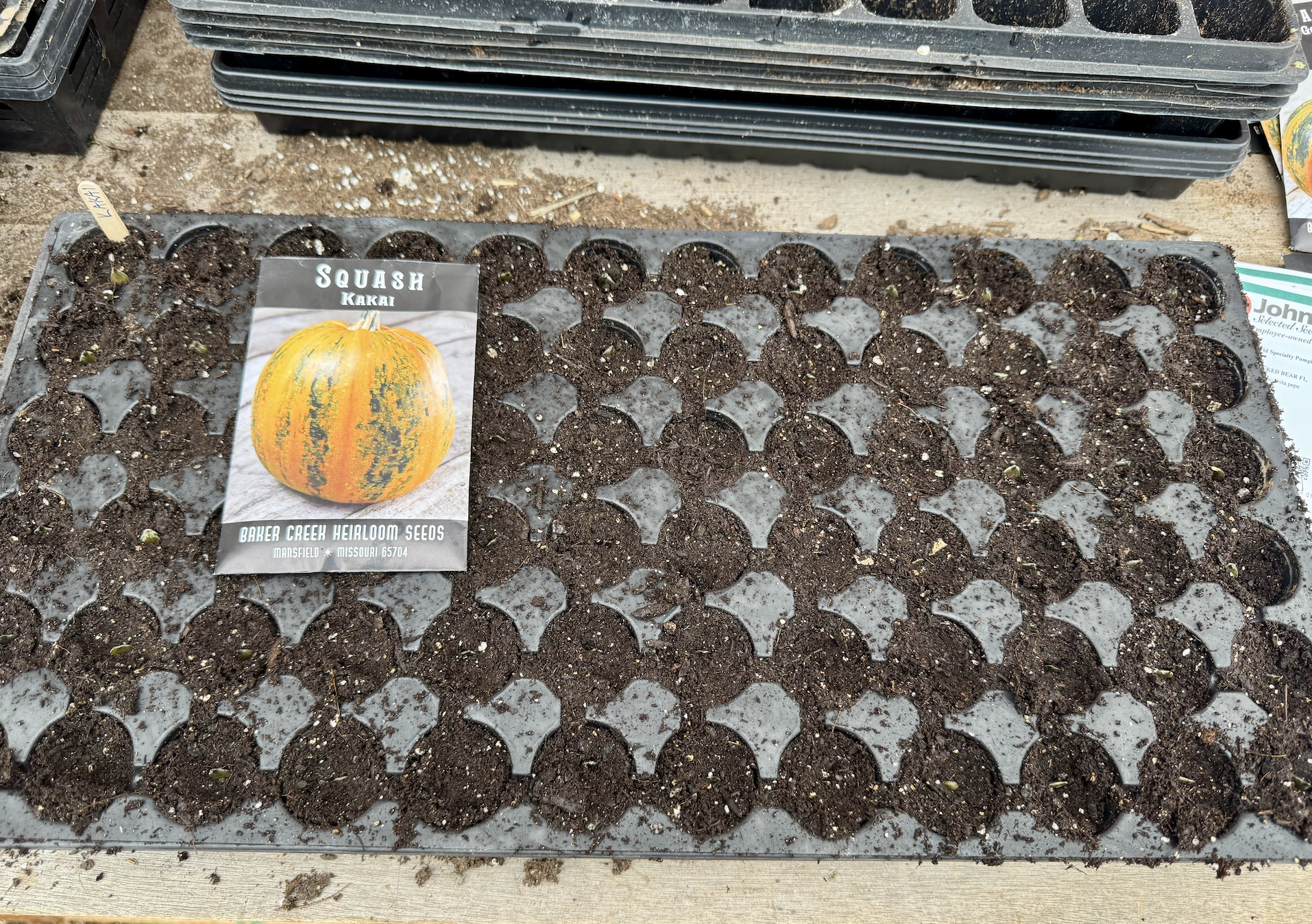
We seeded directly into 72-cell plug trays, using Vermont Compost Fort Vee potting soil. A few nights later, mice discovered and devoured our seeds, an unfortunate (and all-too-familiar) setback. I immediately re-ordered the seeds, but was unable to purchase more Naked Bear seed, so the trial was now reduced to only four varieties.
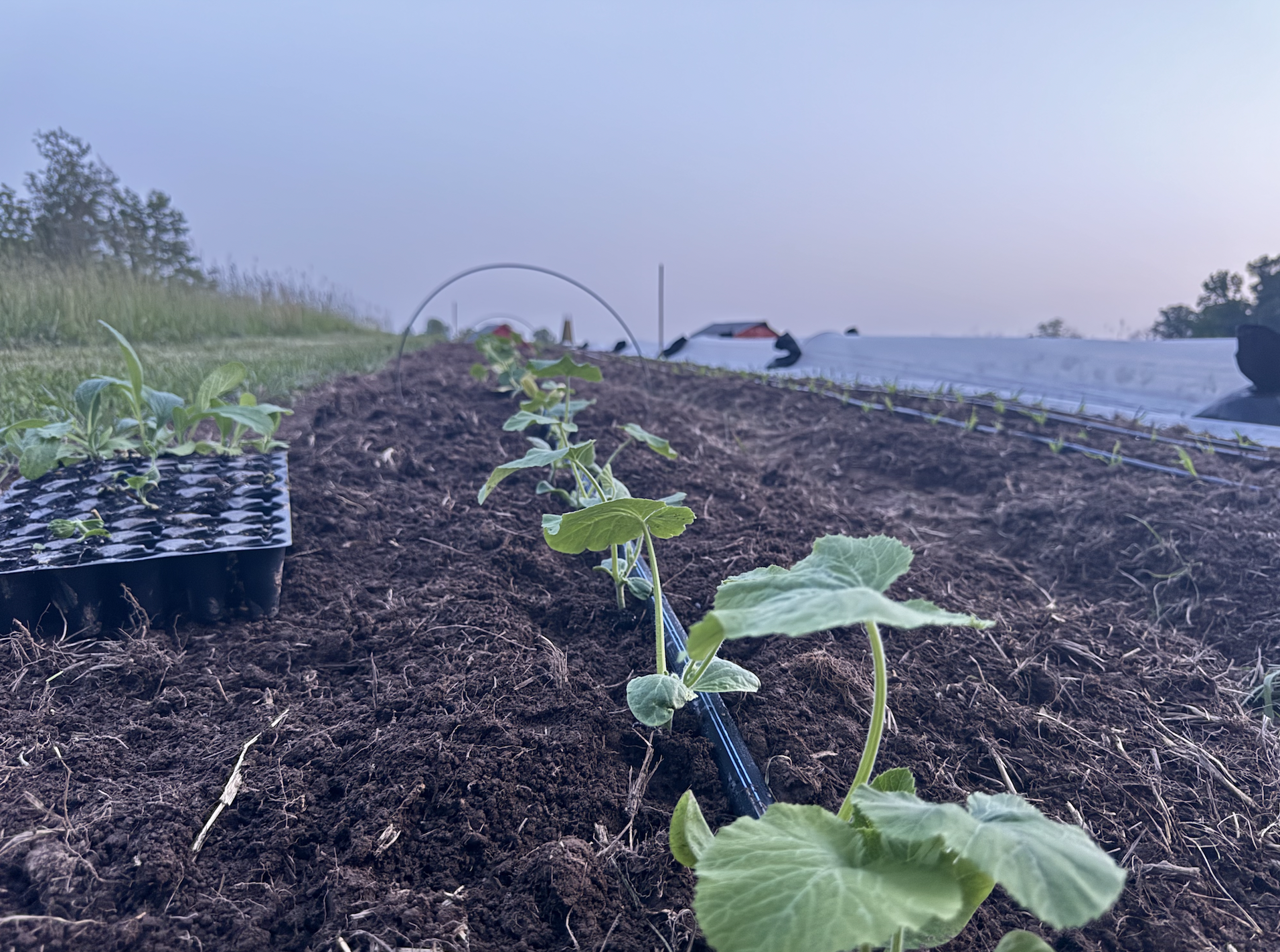
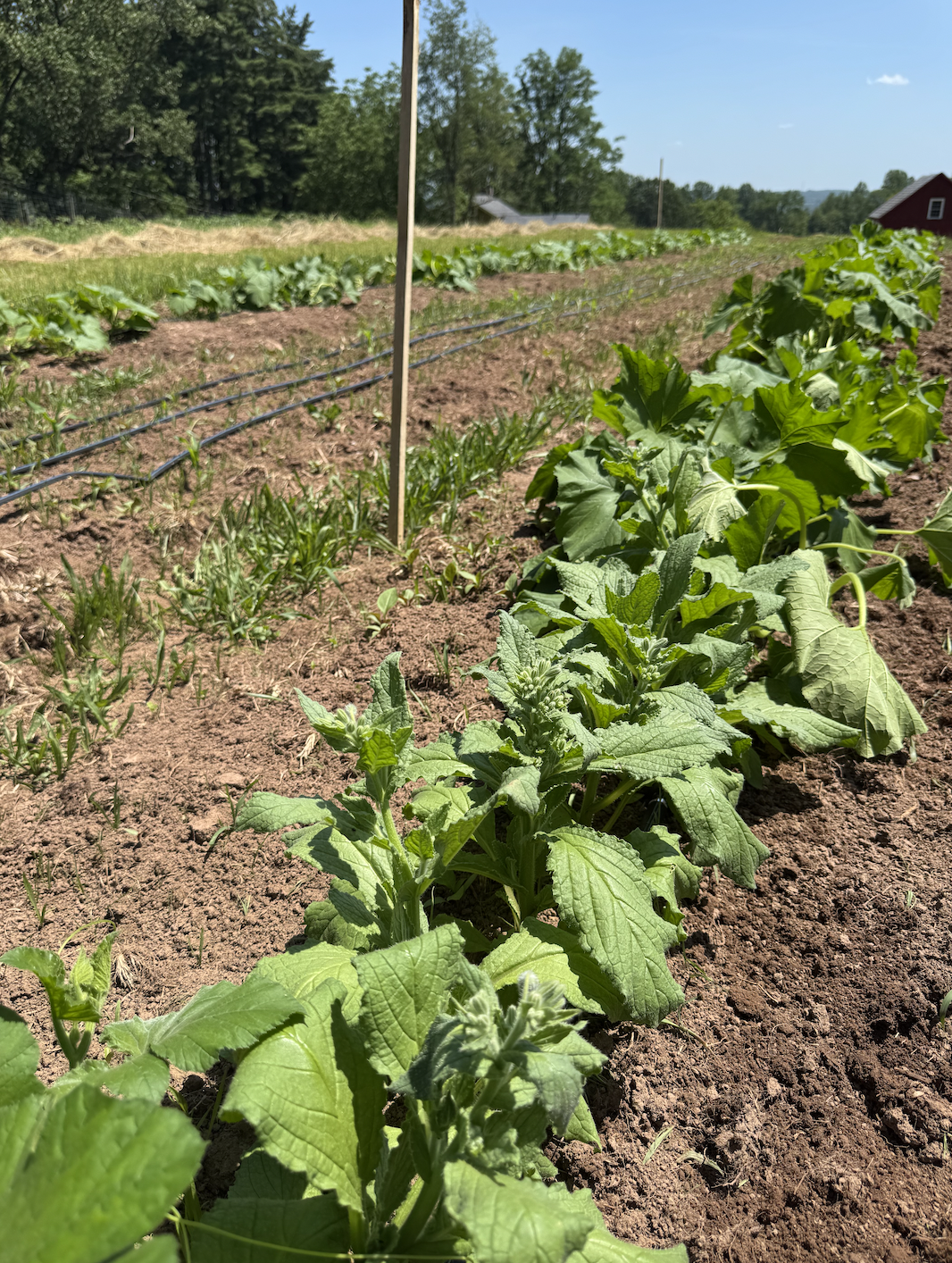
With the delay due to mice damage, the seedlings were hardened off and ready for planting at the start of June. Each variety was planted into its own 100′ bed at 36″ spacing (we planted more intensely at first and later thinned out to proper planting density). We also interplanted borage, dill, calendula, and phacaelia throughout the beds to attract beneficial insects and support our spray-free, organic IPM system. The plants were on drip irrigation, given an application of Down To Earth’s blood meal and langbeinite powders, and placed under floating row cover for protection from pests.
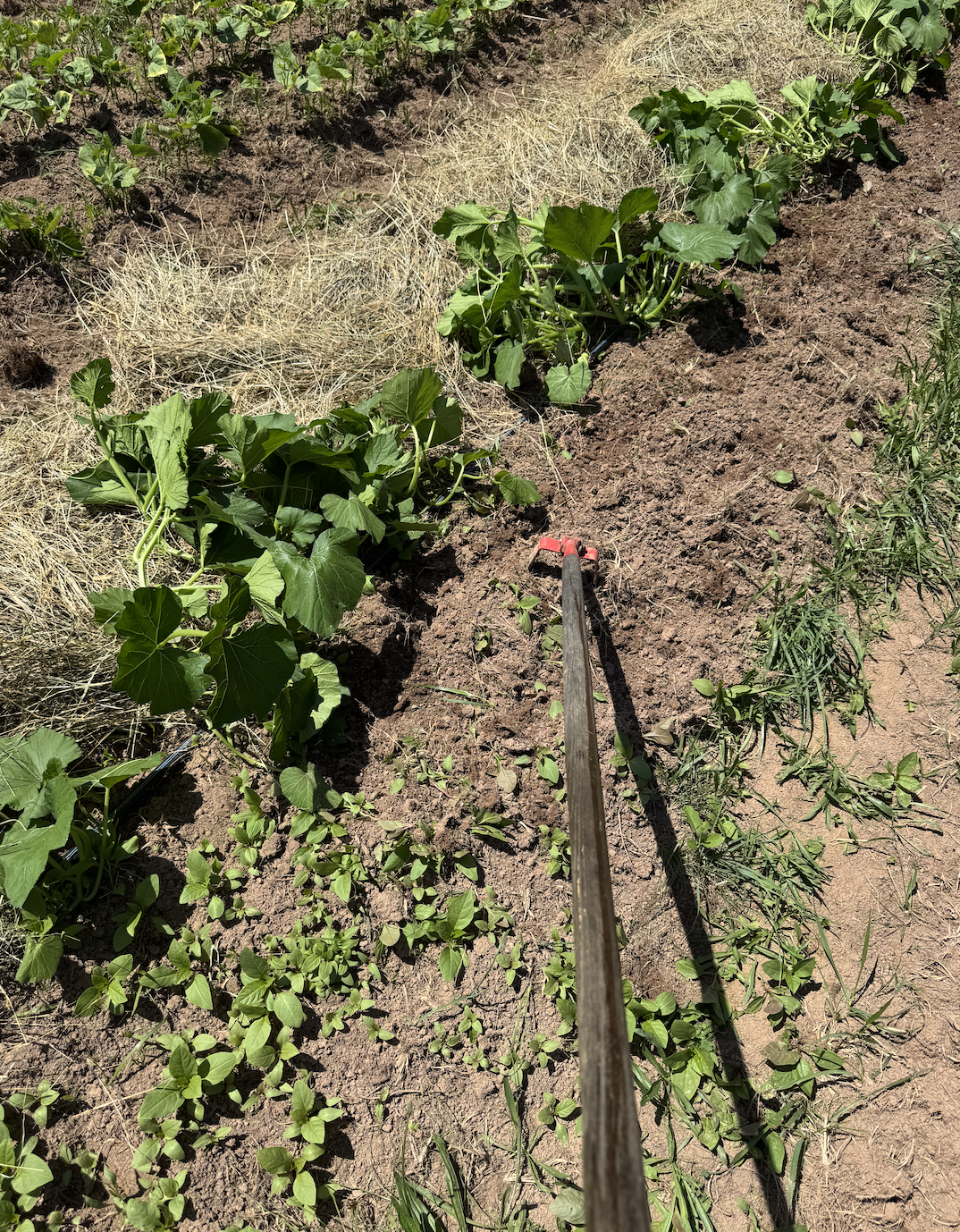
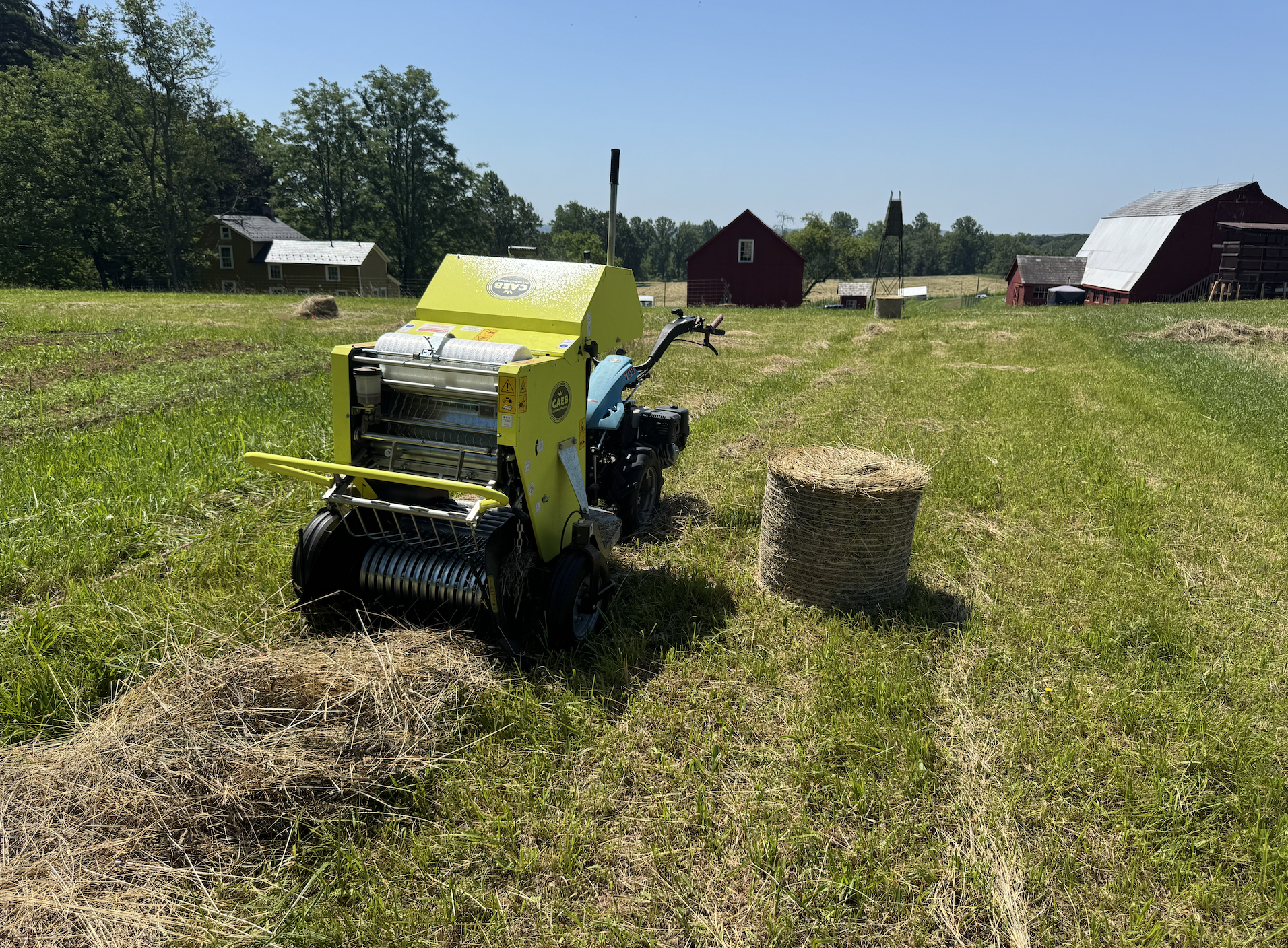
Once the plants grew in, we removed the row cover, cultivated weeds with a scuffle/stirrup hoe, and mulched with the chemical-free straw produced on-site (thanks to equipment from a CFBNJ grant – give a shout if you want help making your own straw mulch!).
Harvest
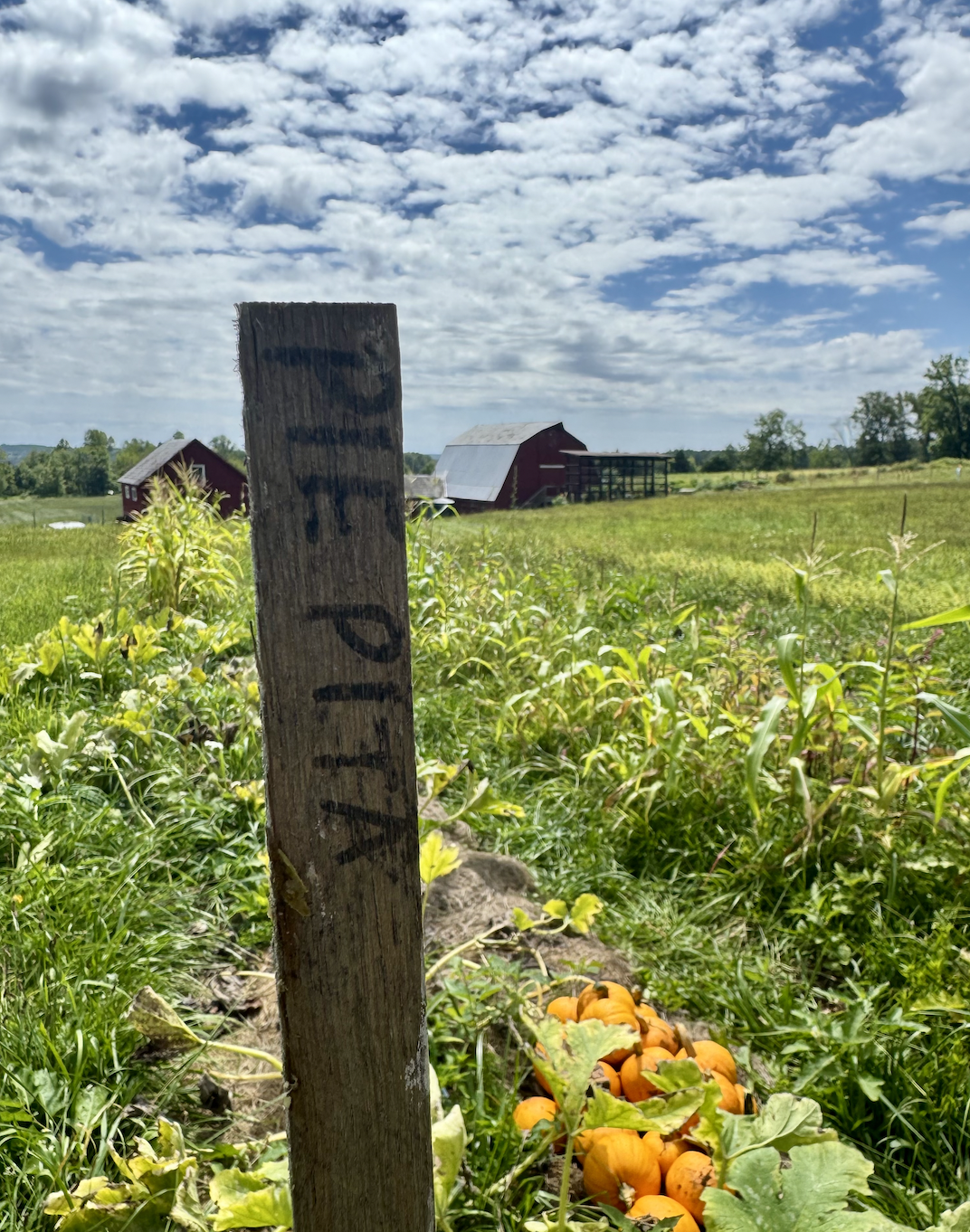
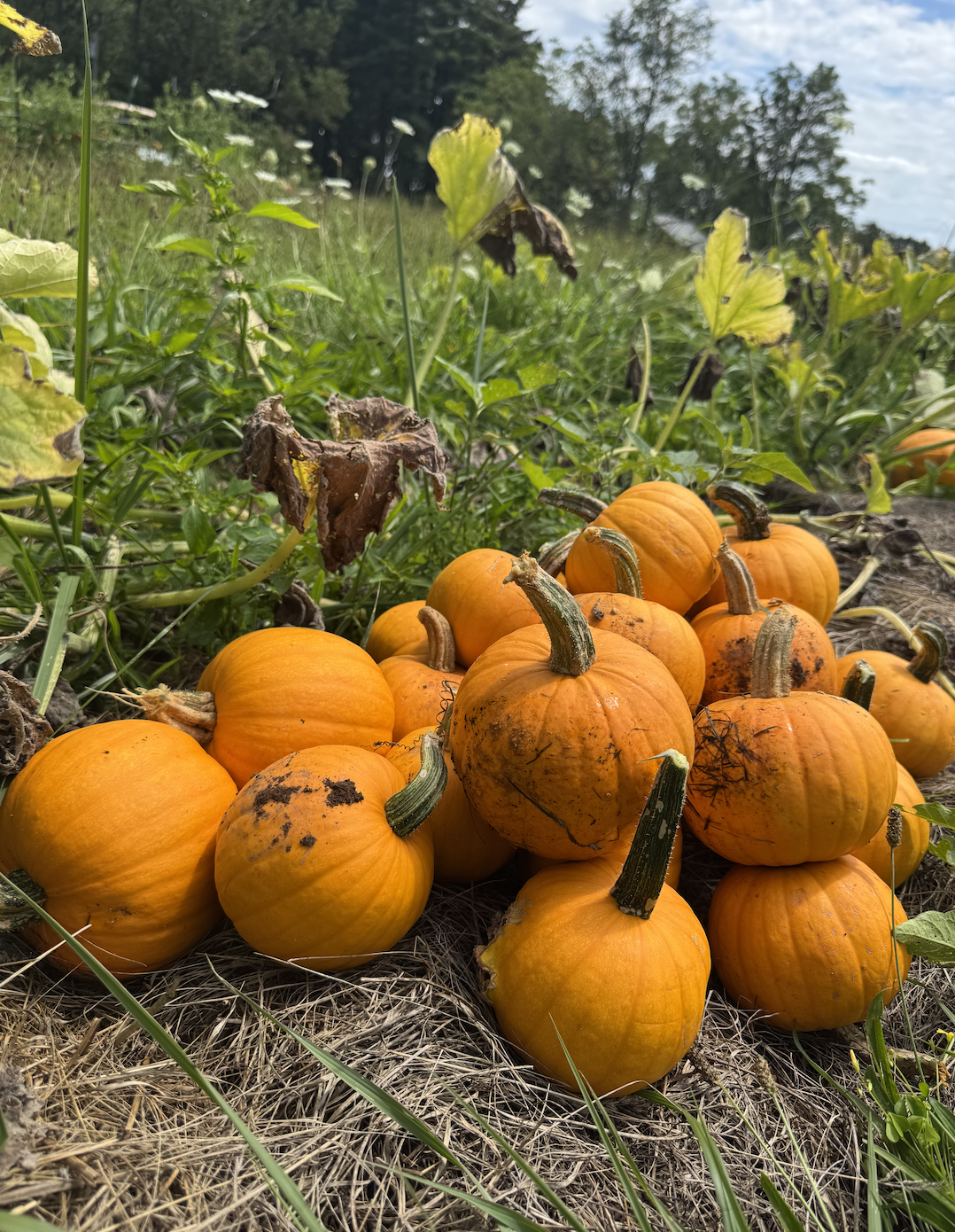
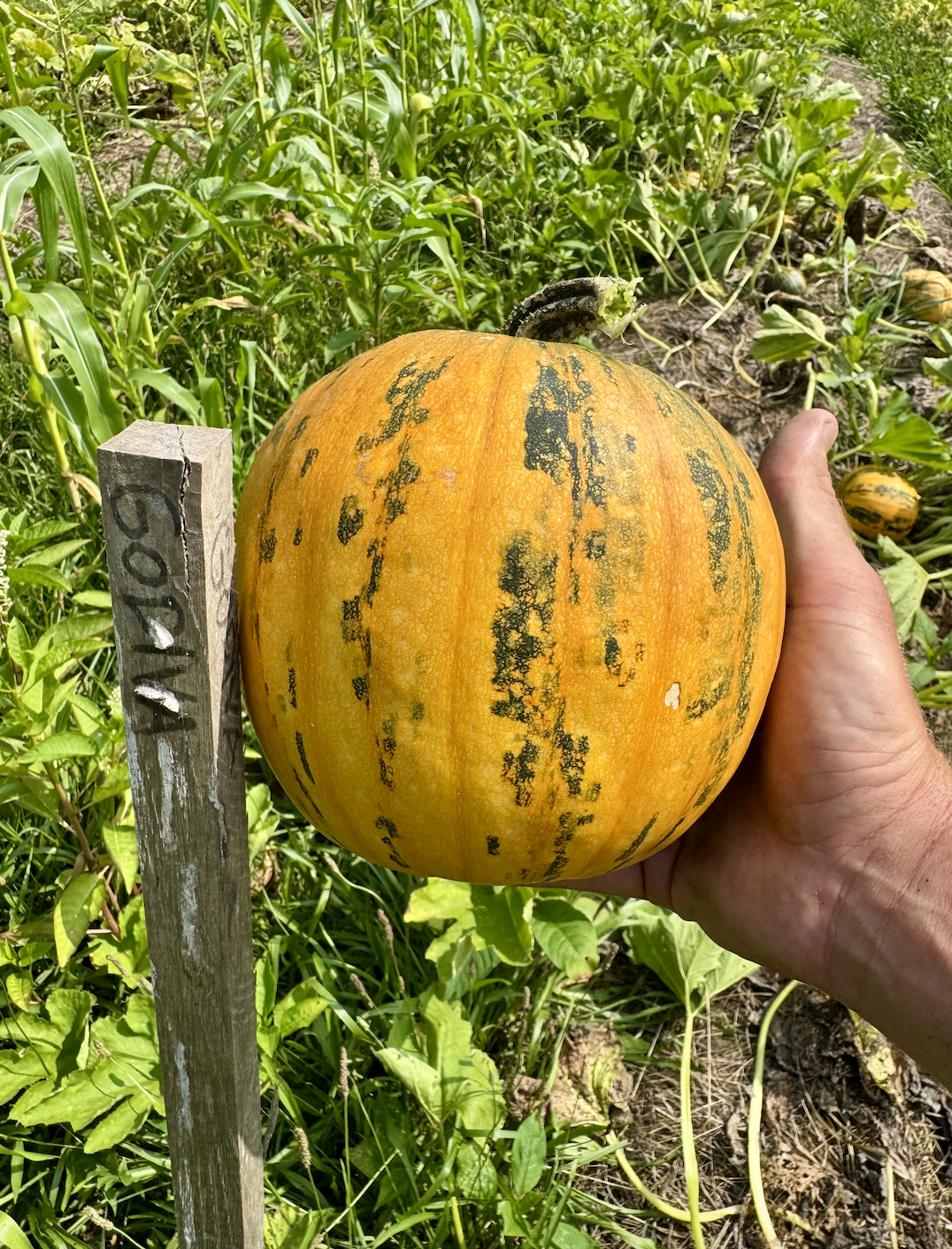
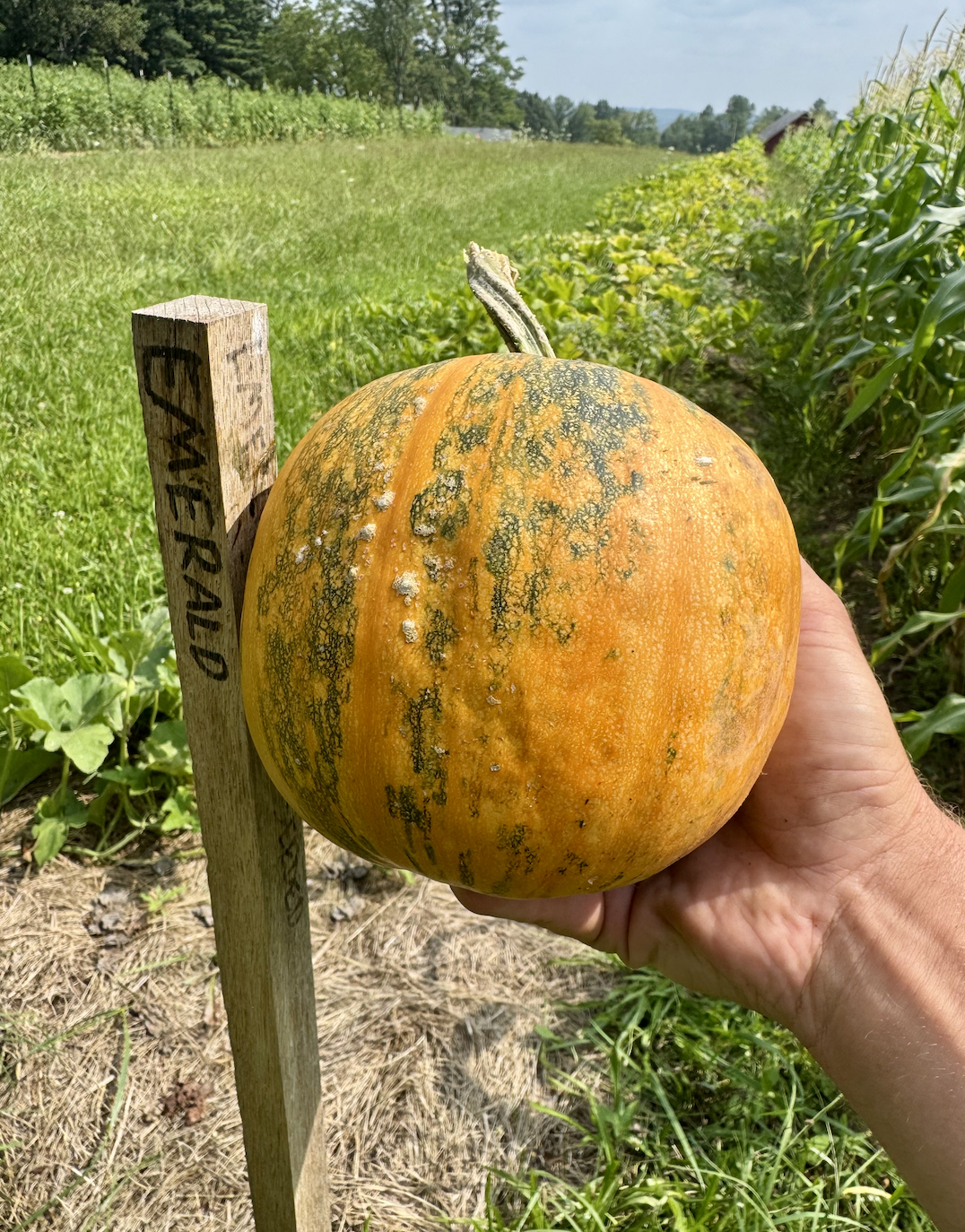
Each variety of pumpkin was harvested and inspected in early August, approximately 90 days after the crop was seeded. The pumpkins were cleaned and set in the barn to cure. At this stage, it is my understanding that the seeds may still mature as they make use of the stored energy in the flesh of the fruit. I also had little time to spare at this point in the season, and conveniently set these little orange wonders aside until the season settled down a bit.
The average weight of each unprocessed pumpkin was:
- Godiva (3.07 lb)
- Kakai (2.54 lb)
- Emerald Naked Seeded (2.43 lb).
- Pie Pita (1.34 lb)
The average seed weight of each pumpkin was: Godiva (0.15 lb); Kakai (0.03 lb); Pie Pita (0.06 lb); Emerald Naked Seeded (0.11 lb).
Average Fruit Weight
The average weight of each unprocessed pumpkin was:
- Godiva (3.07 lb whole pumpkin, 0.15 lb seeds)
- Kakai (2.54 lb whole pumpkin, 0.03 lb seeds)
- Emerald Naked Seeded (2.43 lb whole pumpkin, 0.11 lb seeds)
- Pie Pita (1.34 lb whole pumpkin, 0.06 lb seeds)
Yield Per 100′ Row
Per 100’ row, the following was harvested of each pumpkin variety:
- Godiva (67.54 lb. whole pumpkins, 3.3 lb. seeds)
- Kakai (25.4 lb. whole pumpkins, 0.3 lb. seeds)
- Emerald Naked Seeded (80.80 lb. whole pumpkins, 3.66 lb. seeds)
- Pie Pita (85.76 lb. whole pumpkins, 3.84 lb. seeds)
Process
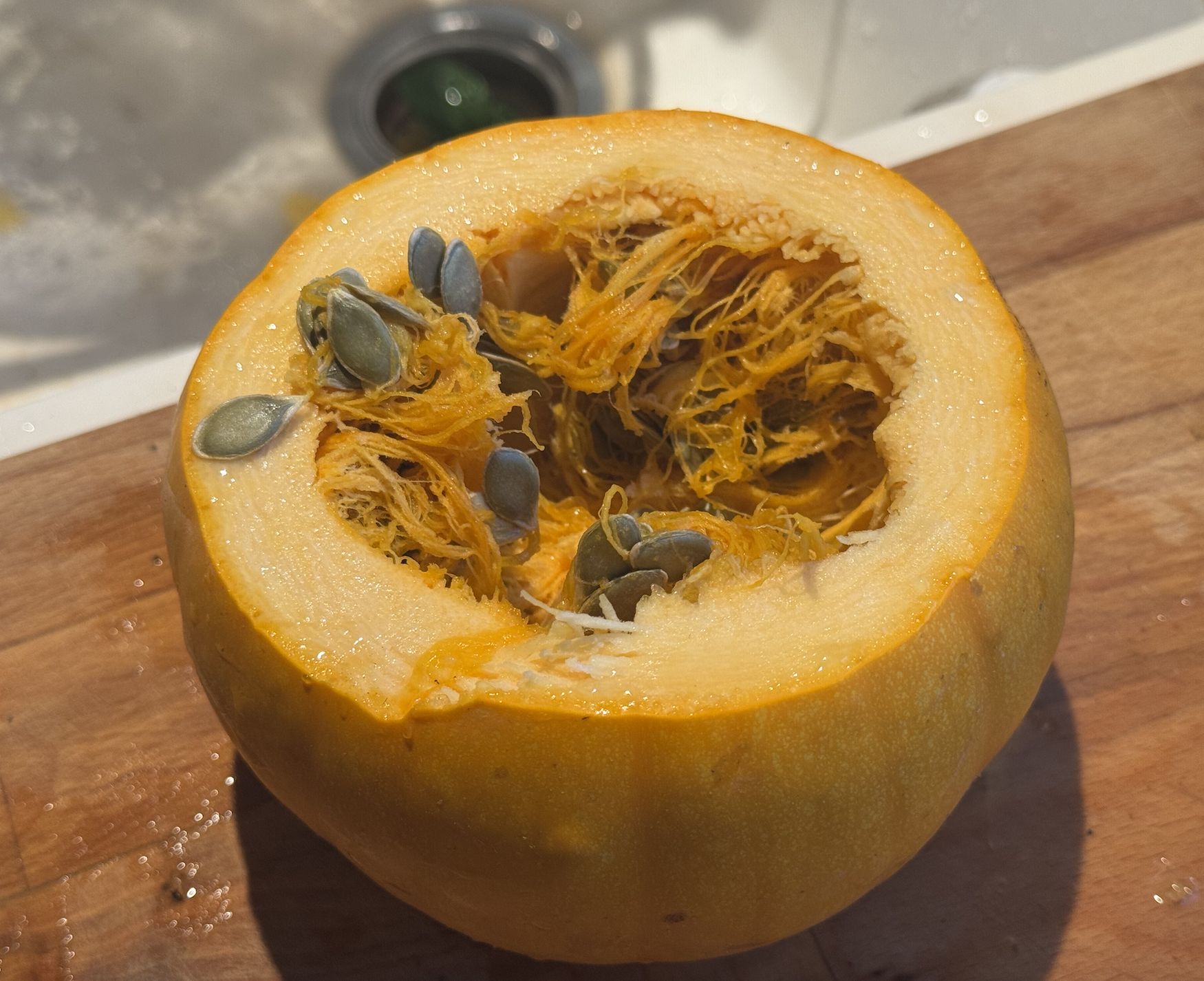
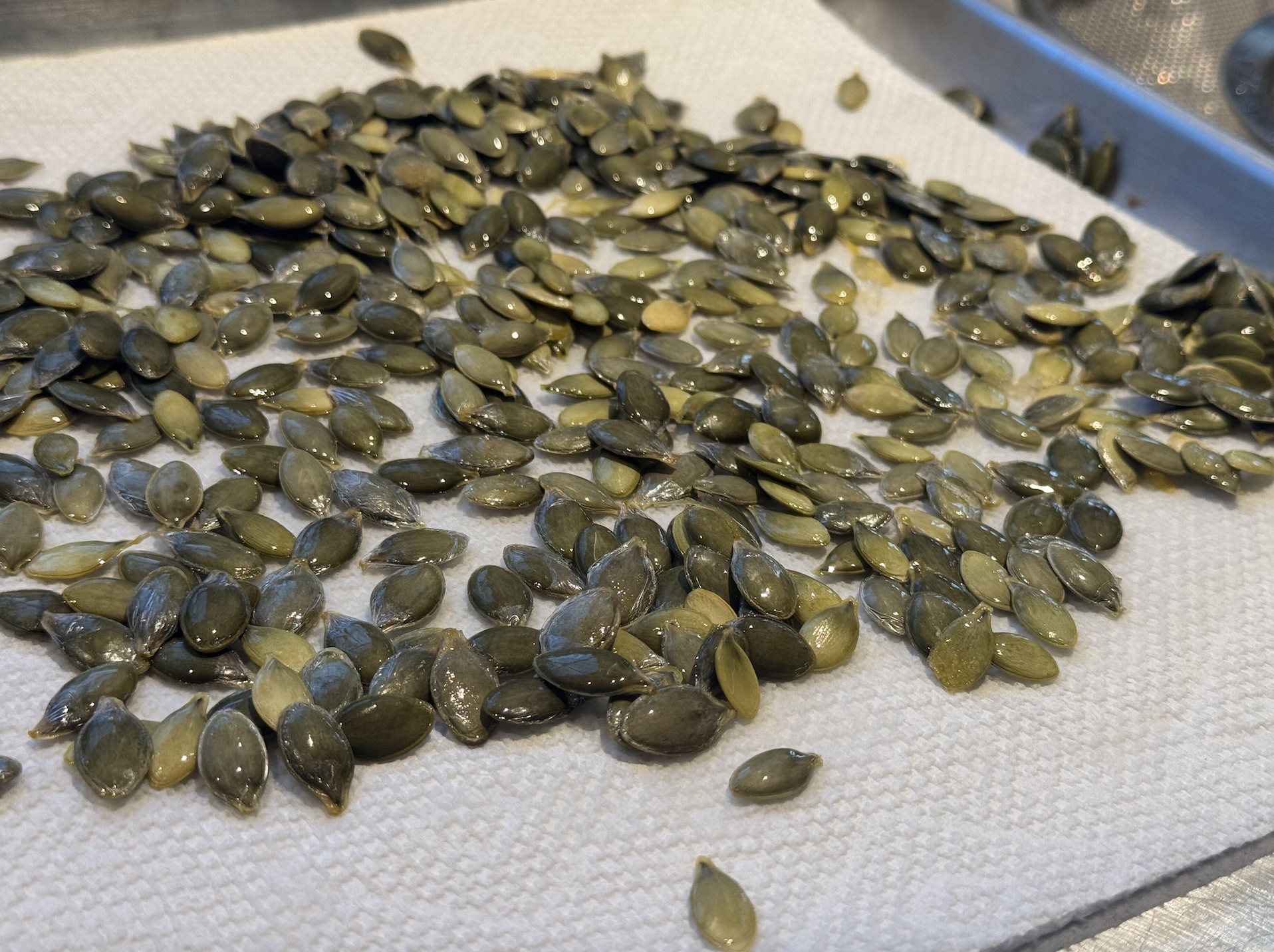
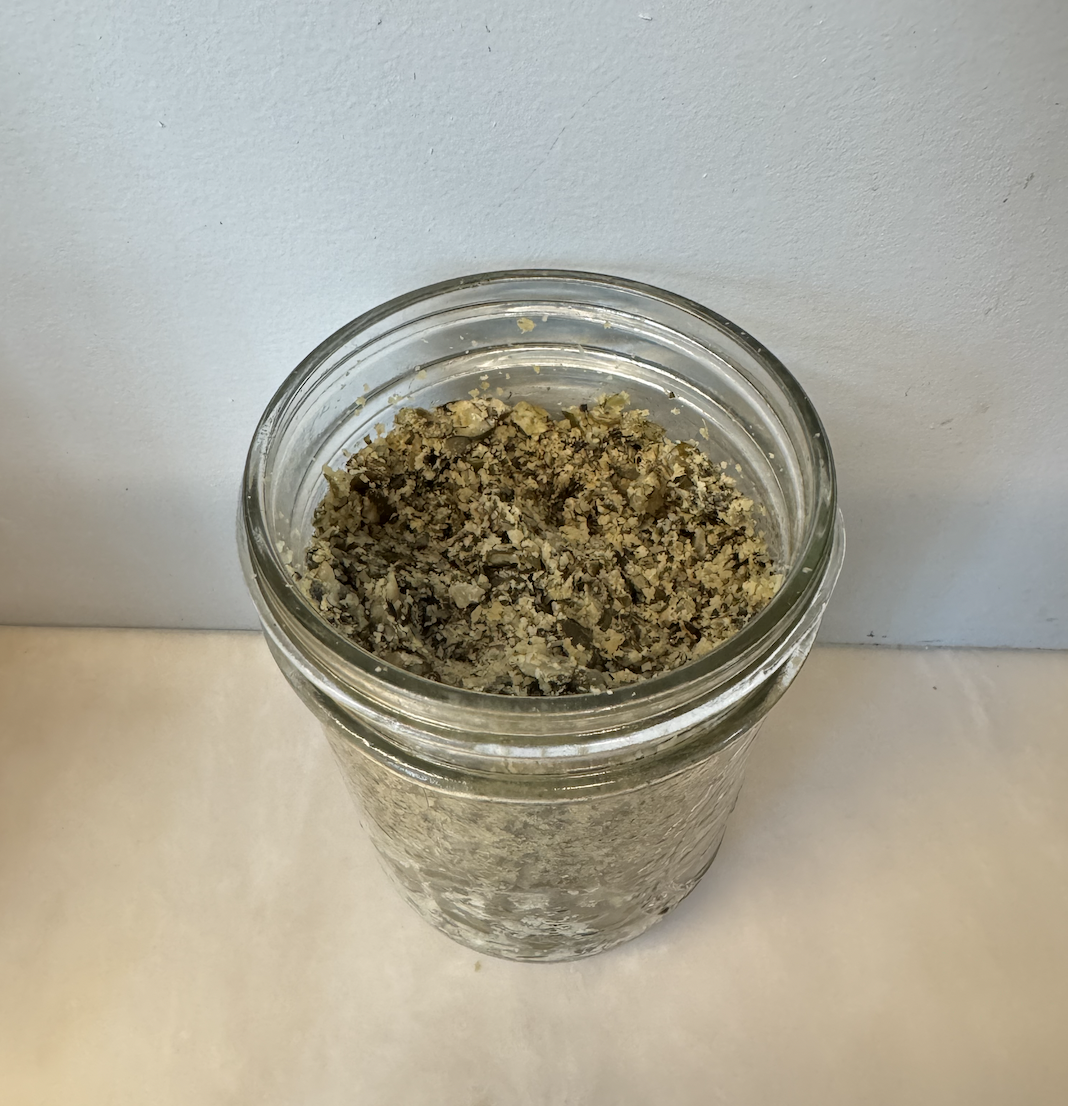
Hands down, the most significant limiting factor in processing hulless pumpkins for seed and/or oil is separating the seeds from the flesh. Large commercial pumpkin seed production features specialized pumpkin harvesting and processing equipment, which I’m still pondering how to recreate on a small scale. For this project, I simply sliced the top off the pumpkin and used lots of elbow grease to scoop the seeds and flesh out (a sharp knife and a strong, sturdy spoon are critical for this step). Next, the most time-consuming activity was separating seeds from flesh, as the seeds cling to the flesh via the funiculus (i.e. a little gourd umbilical cord).
Commercially, this method of processing is nowhere near economically viable, as it is both time-consuming and laborious. Separating seed from flesh using water was also trialed to little benefit, as bits of funiculus remained difficult to remove. For personal consumption, however, the task can be performed in a relaxed setting or with the help of friends or family. Moving forward, I hope to find or develop an improved method and/or equipment to facilitate this step.
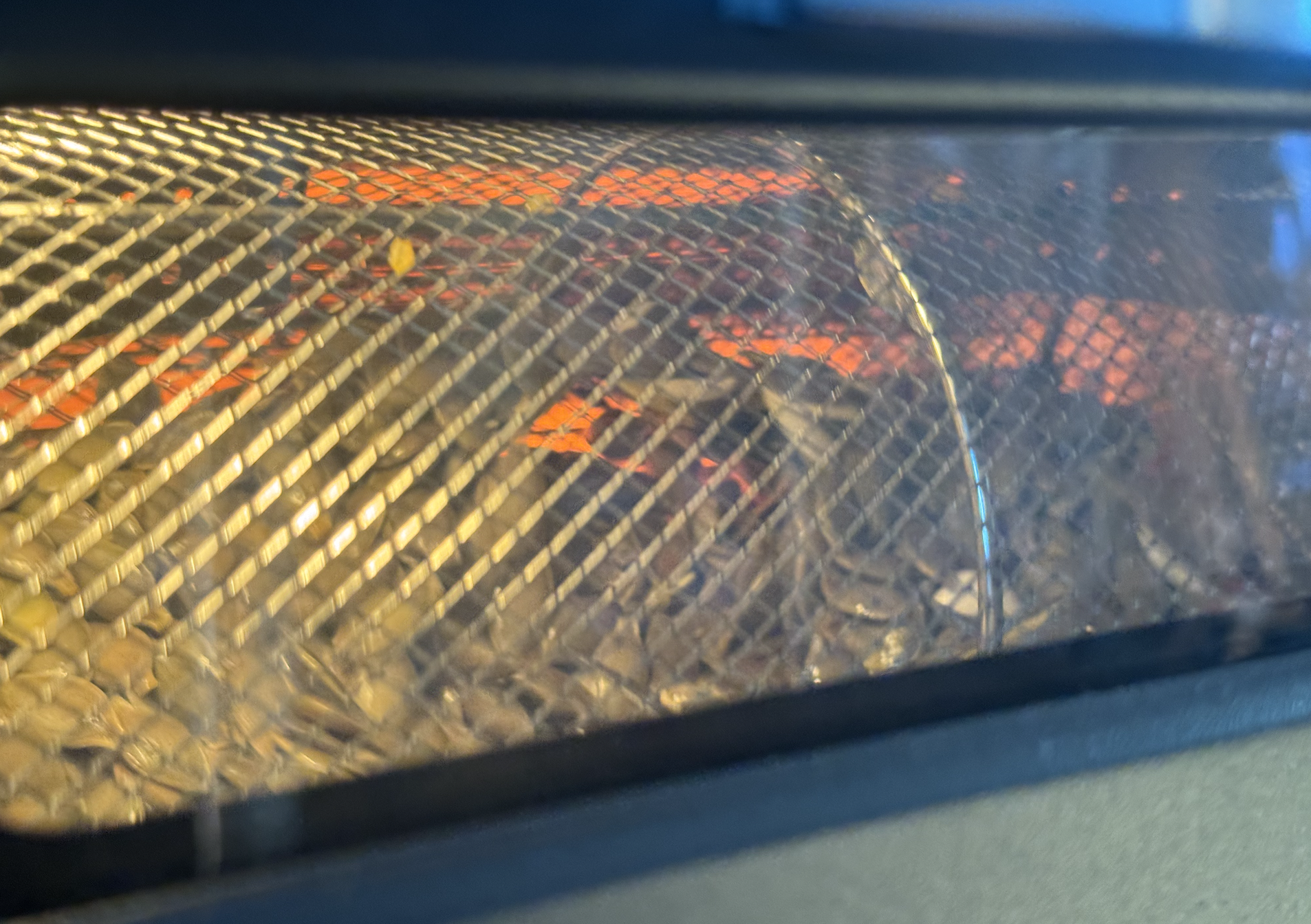
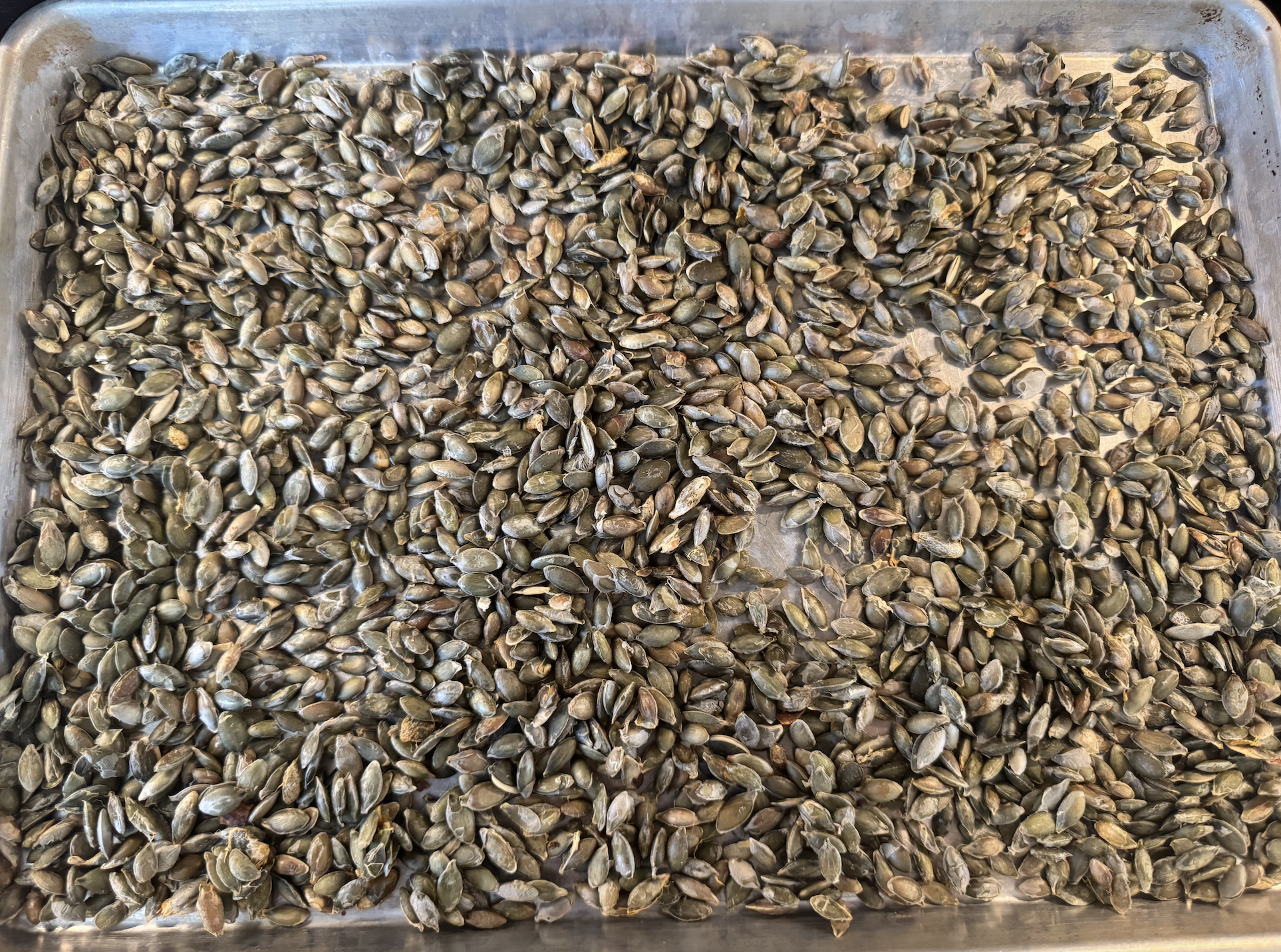
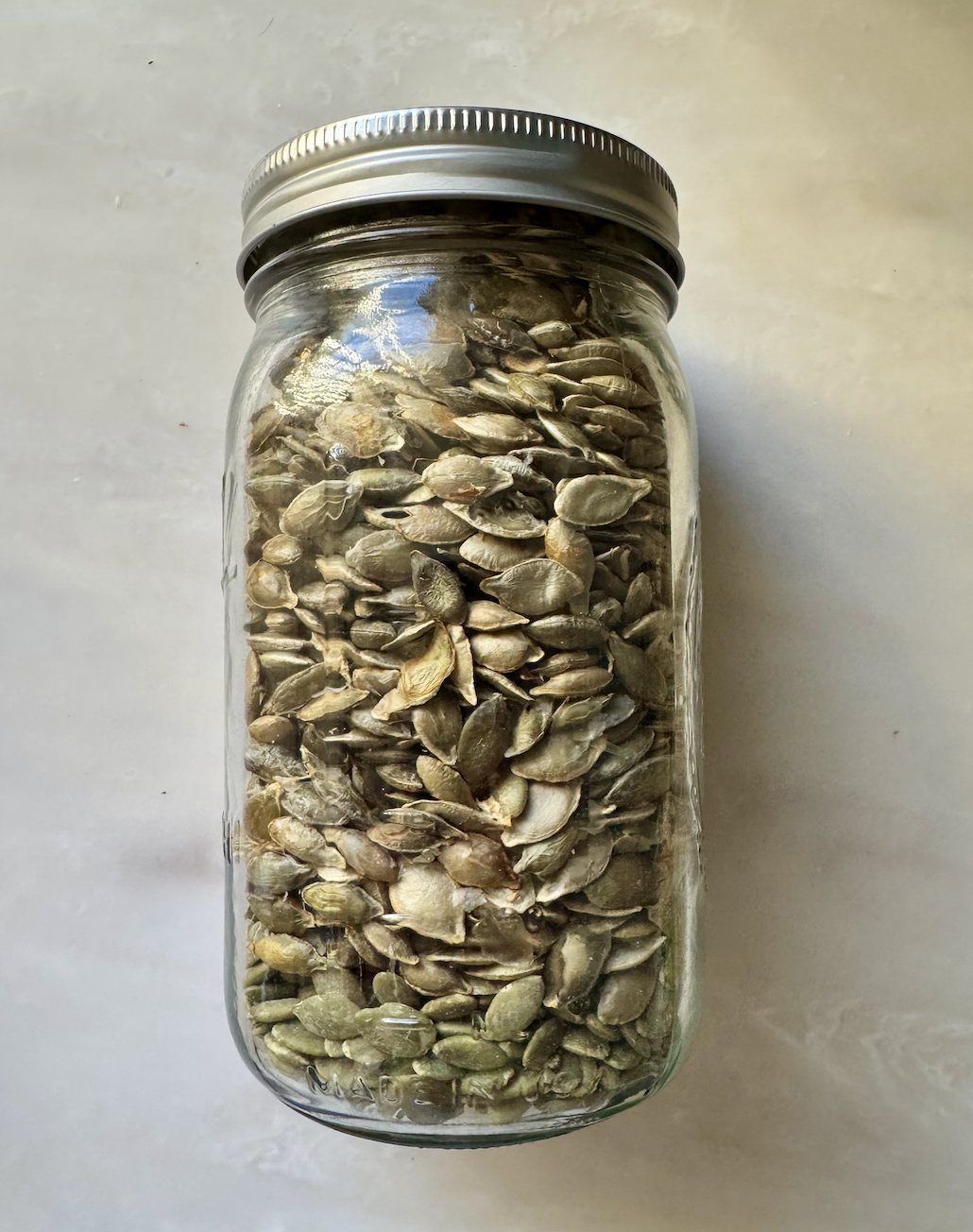
Once the seeds were (mostly) separated from the pulp, different methods were trialed to roast and press the seeds for both oil and for eating whole. A portion of the seeds were left to dry, while some seeds were put into the roaster “wet”. Seeds that were allowed to dry before roasting (approx. 2 hours drying time) produced a superior roasted pumpkin seed and required significantly less time to fully roast. A Burman tabletop coffee roaster was used, as the rotating drum roasting function allows for more even roasting. Conservatively, 8 pounds of seed could be roasted per hour in the small appliance.
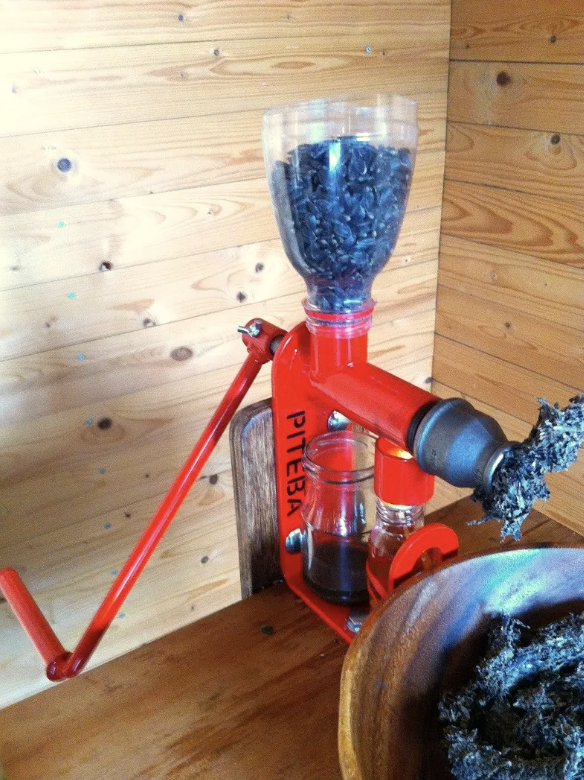
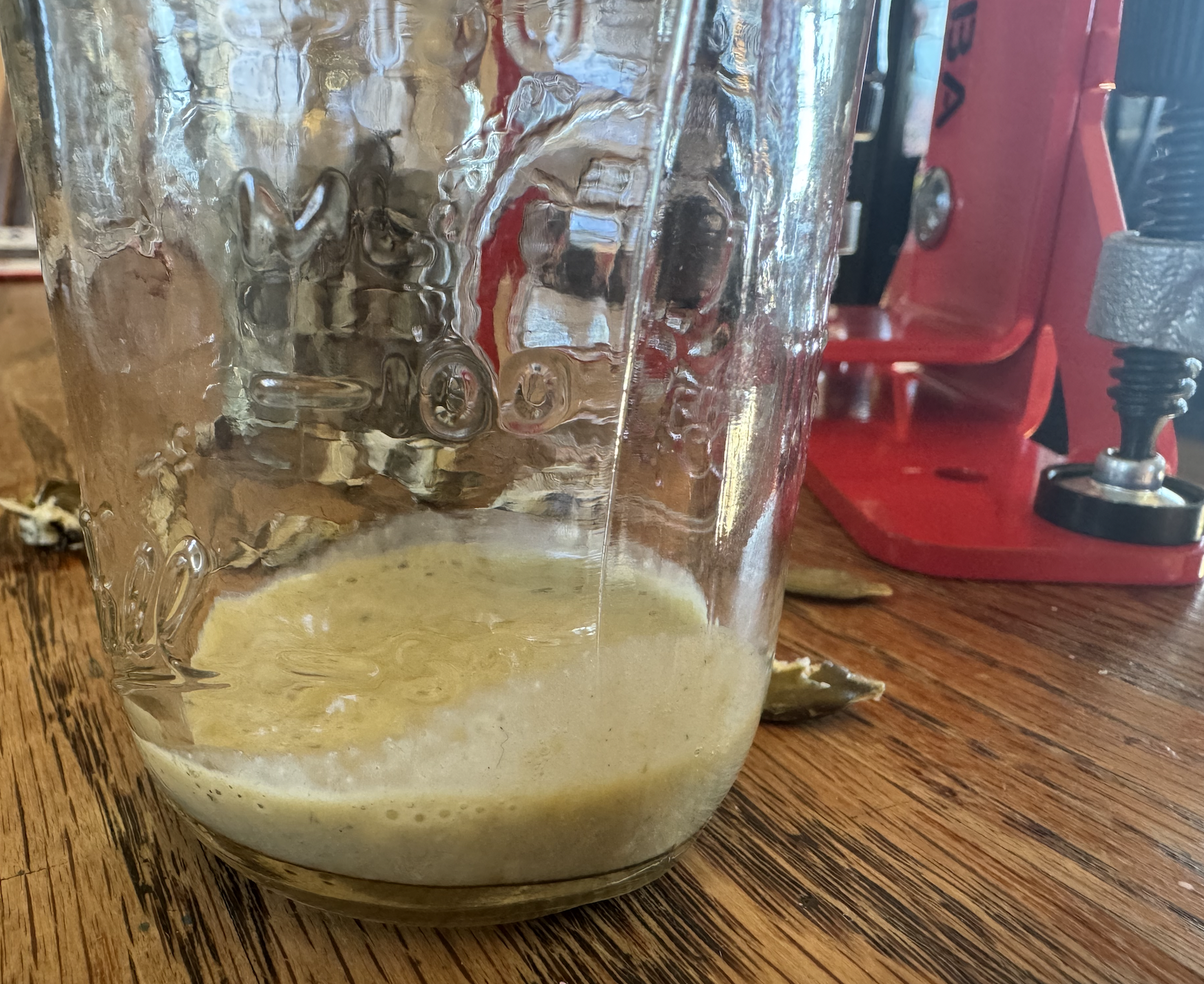
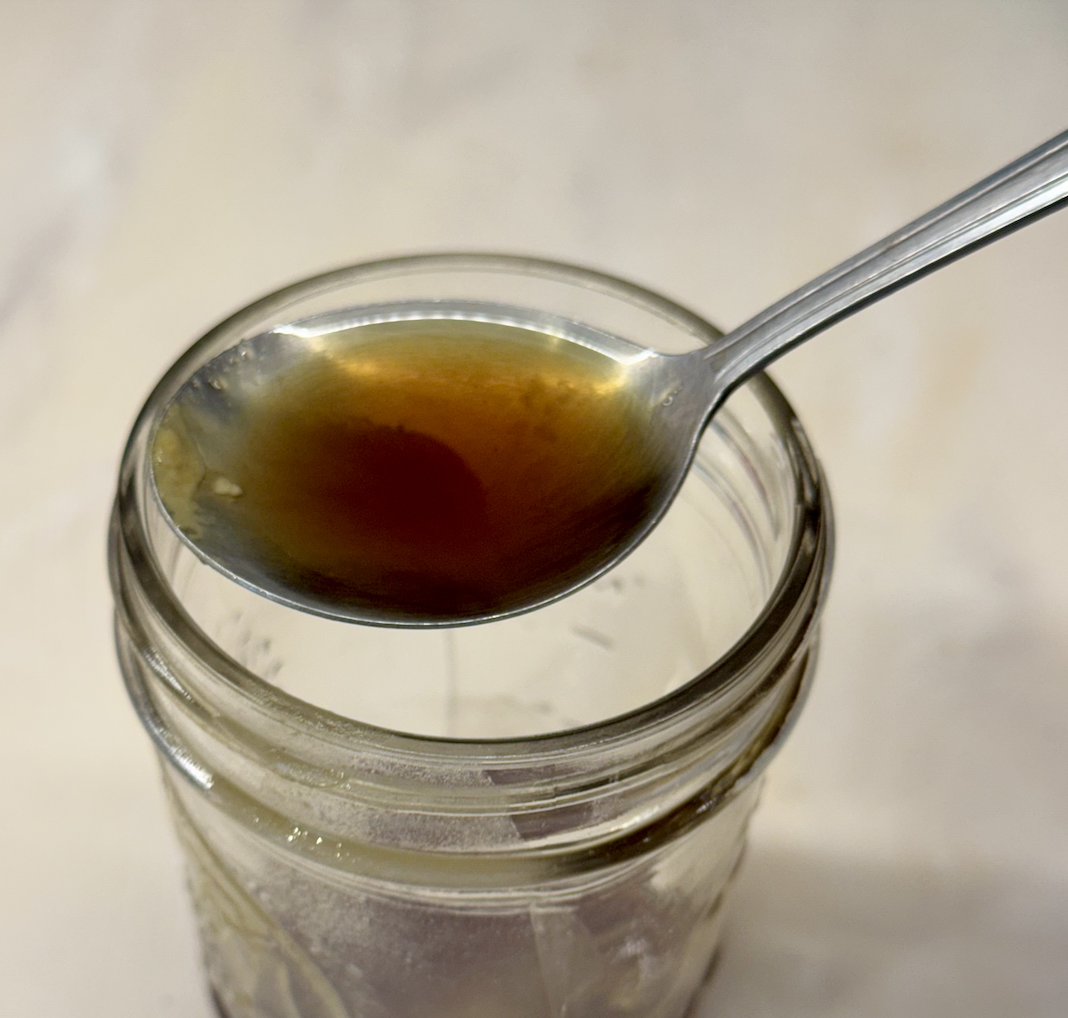
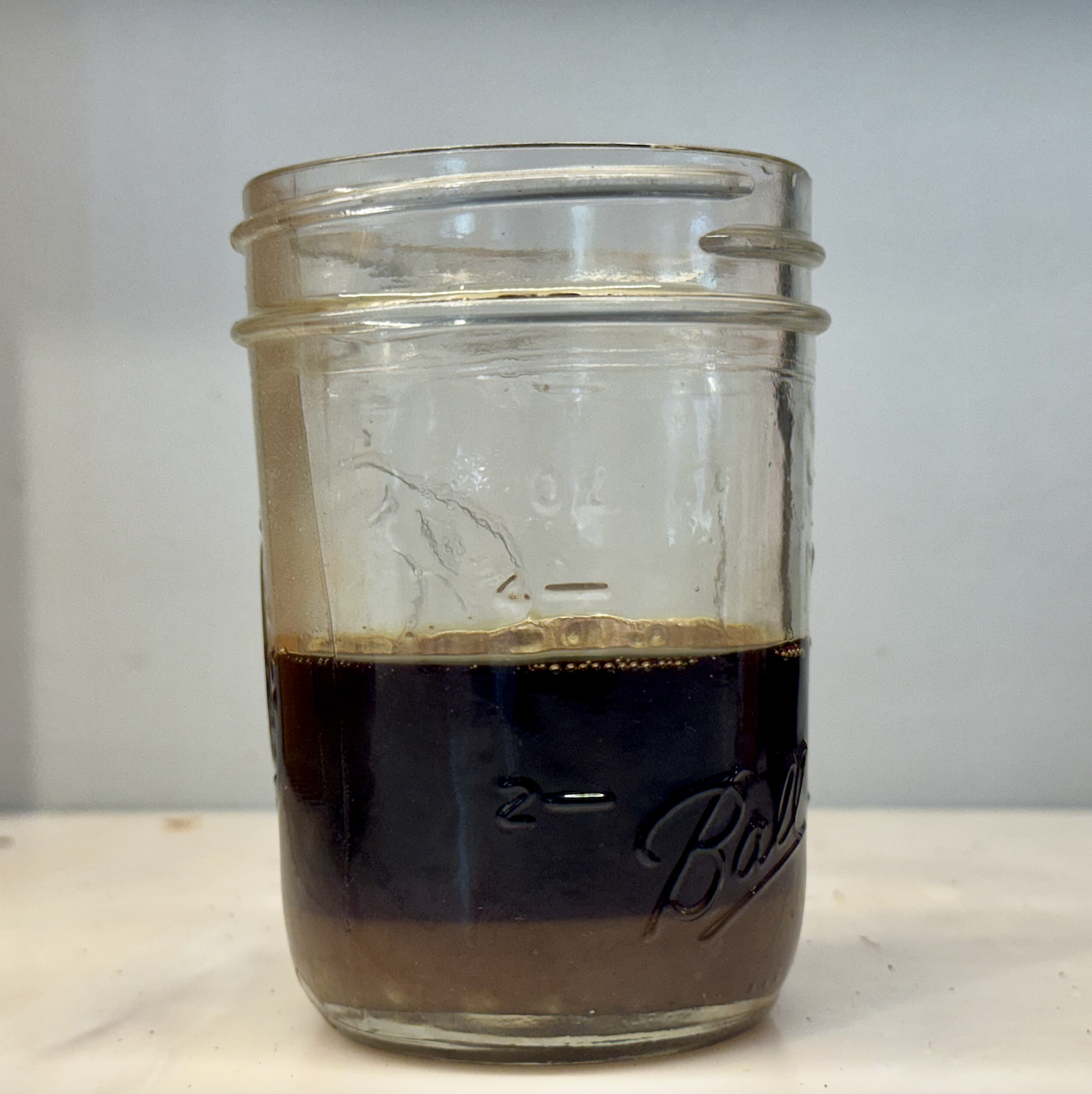
Using the Piteba Press, the highest oil yield came from roasted seeds that were allowed to cool briefly after roasting. Room-temperature seeds don’t release oil as easily as warm seeds, and raw/un-roasted seed produced very little oil from the press. Overall, from the seed that was successfully pressed, approximately 1 ounce of oil was produced per 1 pound of seed.
A rough measurement of seeds allows for the assumption that 1 pound of raw seed equals about 1.5 cups by volume, which yields a slightly lesser amount when roasted, allowing for an assumption that 1 pound of raw seed will yield 1 cup of roasted seeds. This number might be a very conservative estimation, but for the sake of exploring the viability of such an enterprise, I’d rather estimate conservatively.
Project Findings
Regarding variety performance, the following takeaways can be had:
-Pie Pita kept the longest post-harvest and had the least post-harvest rot
-Lady Godiva and Emerald Naked Seeded had superior eating quality, according to Hungry Work Farm Members surveyed
-The overall most desirable variety to continue trials with is Pie Pita, both for the yield of fruit, fruit-to-seed ratio, and superior keeping post-harvest
This project highlighted the critical need for processing equipment that is scale-appropriate for small farms and/or cooperative groups of small farmers. As the only pumpkin seed processing infrastructure that could be found was designed for very large farms, the biggest impediment to profitably growing, processing, and marketing pumpkin seed oil and pumpkin seeds is the labor involved in scooping out seeds, separating seeds from pumpkin flesh, and roasting in small batches.
Overall, growing the pumpkins for oil was not found to be viable, producing only 1 oz. per pound of seed, though my lack of experience in pressing seeds for oil does not serve as a viable authoritative finding. On the other hand, the pumpkin seeds themselves prove to be a more viable product for farmers, often sold for upwards of $10/lb. at Organic and specialty food stores.
Extrapolating the data from the project, a successful grower might produce upwards of 500 lbs. of pumpkin seeds per acre. Not factoring in the cost of production, processing, or marketing, gross sales of Organic pumpkin seeds could hypothetically exceed $5,000 per acre. Beyond sales, the prospect of adding value to an operation – whether adding variety to the farm’s offerings, or offering on-farm/hands-on engagements around pumpkin seed processing – makes further exploration of hulless pumpkin seed production exciting.
As part of the grant, we engaged visitors and Hungry Work Farm CSA members to promote this specialty crop and to solicit feedback on product demand and quality. Originally, the plan was to attend the Hunterdon Community Farmers Market, but we opted instead to test the seeds and oil with CSA members. All Members surveyed provided positive feedback on the seeds, confirming that they would purchase a roasted pumpkin seed product for $10/pound and that the quality of freshly-roasted seeds was far superior to what is commonly available in grocery stores.
Project Challenges
While this project validates further exploration of hulless pumpkin as a potential specialty crop and value-added food product, I was unable to fully succeed in the plans laid out in the project submission. A short list of challenges include:
- Pest damage in the propagation house set back plantings by about two weeks
- First-time use of the Piteba oil press had a learning curve, and results should be questioned due to inexperience in oil processing
- In full transparency, the capacity to process pumpkins and report on the results was limited, and given the timeline of the grant, an extension was requested to properly fulfill project deliverables
- There is a limited variety of hulless pumpkin seed available from seed suppliers
- Failure to engage Rutgers Cooperative Extension and the Rutgers University Bioanalysis lab for external project support as written in the project proposal
- Lack of guidance and/or infrastructure to support small-scale processing of pumpkin seeds
Additional Resources
Much of this project was inspired by Will Bonsall, best known for his work in preserving crop diversity and writing in various publications. Will is the Director of the Scatterseed Project. Here is a fantastic article on oilseed pumpkins that Will published through MOFGA in 2013.
More information on naked-seeded pumpkins was found from a publication produced by the University of Minnesota Agricultural Experiment Station. Here is another article profiling Hay River Farm in Wisconsin, a producer of a variety of seed oil crops.
Both the Piteba Press and the Burman Tabletop Coffee Roaster will be available for producers to utilize in NOFA NJ’s Farmers Process Community Kitchen in Milford, NJ.